The Bruce Family of Grangehill and Falkland
Marietta Crichton Stuart

Margaret Stuart Bruce

Professor John Bruce
My talk is on The Bruces of Grangehill and Falkland; it is the story of Professor John Bruce
and his niece and heir Margaret Stuart Bruce who was to marry Onesiphorus Tyndall – it is
a tale of places, connections, politics, social status and money.
Let’s start with some introductions,
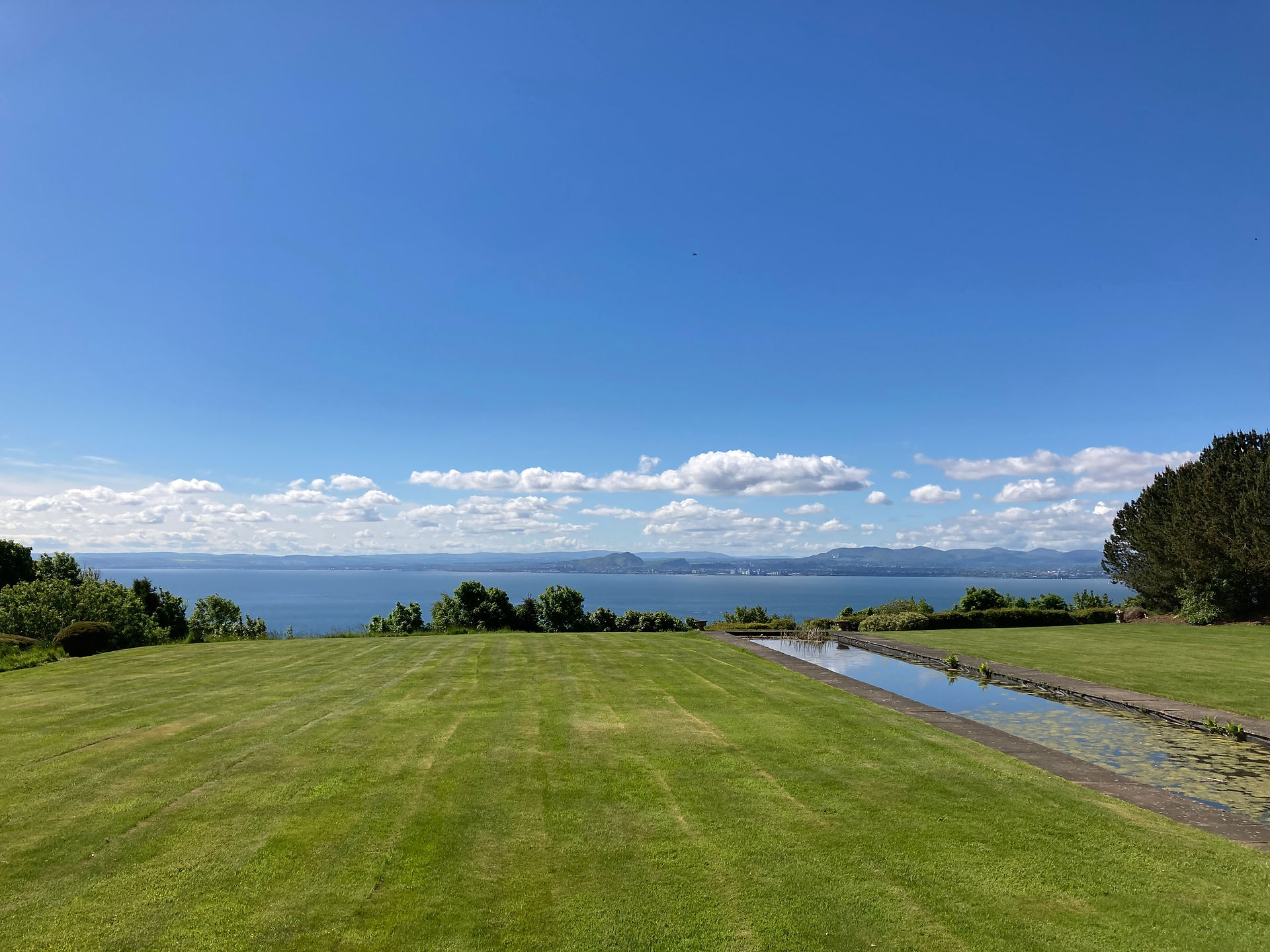
Here we are in Grangehill – A few years ago Steven Blench wrote a history of Grangehill
House and the lands of Grangemire which tells the confusing story of the land sometimes
called Grange or Grangemyre, the farm and the house. The first written evidence of the
Bruces at Grangehill is in 1723, but it is possible that Grangemyre was purchased five years
earlier by Robert Bruce, a well connected merchant and former baillie of Kinghorn. He
was succeeded by his son, also named Robert, who was employed by his uncle Andrew
Bruce, a Dutch and East India merchant. Robert Jr was married to the daughter of the burgh
clerk of Kinghorn and they had ten children, but it was his third son Andrew who inherited
Grangemire in about 1754.
Andrew who styled himself Captain was a shipmaster who, at one time, reputedly had
£15,034 in cash in Great Britain. In 1740 he married Jean Squyre of Forres and they had
three children. John the eldest born in 1744, Robert and Margaret (who was known as
Peggie). In 1761 Captain Andrew Bruce was on a voyage to South Carolina and died on the
brigantine Betsey after it had been ransomed by a French privateer, he was apparently in
the service of his country. Sometime before that the farm of Grangemyre was advertised to
let and Grangemyre started being referred to as Grangehill. It is possible that the Bruce
family had a house while the farm and its farmhouse were separate entities, but Grangehill
was not a regular family residence from about 1760.
Captain Bruce left his eldest son John 300,000 merks and what was described as the small
property of Grangehill and Peggie was left 50,000 merks. It has been suggested that their
widowed mother brought up the family in straightened circumstances and it may have been
at this time that they moved to Edinburgh. John was not destined for the life of a merchant;
an accomplished scholar he was educated at Edinburgh High School and then went to
Edinburgh University. In 1763 a commission was purchased for his 12 year old younger
brother Robert in the Bengal Artillery which was closely tied to the East India Company;
Robert then spent most of his life in India, rising through the ranks, enriched by booty and,
as he wrote home, in India he became “somebody”. In India Robert had at least two
daughters with a native woman. Only the younger girl survived, she was Margaret Stuart
Bruce. Her father Colonel Robert brought her to Edinburgh as a young child, her parentage
was initially kept a secret, and she was raised in the Bruce family home in the New Town;
later, through her father and uncle, she became a wealthy and eligible heiress and in 1828
married a Bristol born barrister named Onesiphorus Tyndall.
And what about Falkland? Once the Scottish court moved south to London, responsibility
for the Palace of Falkland fell to the hereditary Keepers – the Stormonts, Atholls and later
the Skenes of Hallyards and Pitlour. The building fell into disrepair, was frequently used as
a stone yard by the locals and the minister lived in some wretched rooms in the south range.
At the heart of this story is the estate of Earlshall near Leuchars. In 1774 Helen Bruce of
Earlshall died, three people claimed the estate, one of these was John Bruce, his claim was
via his 3 times great grandfather Sir William Bruce of Earlshall. He was able to
successfully establish his legal status as heir male to the House of Earlshall. However in
1777 the Court of Session preferred the claim of Sir Robert Henderson of Fordell a nephew
of Lady Helen’s late husband. This was a huge blow to John and was to shape much of his
later life. On 31st December that year he wrote in his notebook in the third person “Mr
Bruce was thus deprived of the estate of his ancestors by one of those perversions of
justice, shielded by the forms of law, which have often been the source of misfortune for
those that suffer from them though not of the purest principle of morality in those who
practice them”
John had already done some work for the East India Company and visited Versailles; he
wrote to his cousin Andrew Hamilton “I have often seen his Majesty, as ugly as bad
features and stupidity can make him. The Queen is handsome but unfruitful.”
By 1785 John Bruce was successfully established in Edinburgh academia and society. At
the university he had been a founding member of the Speculative Society, a Scottish
Enlightenment Society dedicated to public speaking and debate.
This had been achieved with the encouragement of the University’s Principal William
Robertson. Bruce lectured and had been the temporary occupant of Adam Ferguson’s chair
of moral philosophy; he later became the Professor of Logic and one of his pupils was
Walter Scott. He was member of the Royal Societies of Scotland, England and Gottingen in
Germany. It was noted that he was reliant on patronage and adept at getting it. He
transferred his allegiance from Robertson to Henry Dundas, sometimes described as the
“political manager of Scotland”, who, together with William Pitt, brought the East India
Company under the supervision of Parliament. Dundas, later Viscount Melville, had a
network of patronage and was highly influential in Bruce’s life. The massive Hamilton
Bruce archive in the National Records of Scotland shows the range of John Bruce’s
contacts including George Washington in Philadelphia and William Pitt in Downing Street.
Around 1785 the Professor’s brother Colonel Robert arrived back in Edinburgh on furlough
from India, the first time he has been home in about 15 years. He had previously
corresponded with John about his daughter by an Indian woman and had even broached the
subject of John acting as the child’s guardian. The Professor responded that it was
impossible to introduce such a child into genteel Edinburgh society and Robert replied he
had never meant that she should be “unfortunate enough to go near Scotland”.
He wrote that he had no intention of embarrassing the Bruce family with his quote “little
black connections” This child died in India, but when Robert arrived he had with him a 4
year old girl, his second daughter, he kept her parentage a secret and passed her off as
Margaret Stewart the daughter of a friend.
It is probable that Robert had been sending money back from India and it may have been
this which purchased a three-storey house in the New Town for his mother, unmarried
brother and sister; possibly this was 42 Princes St with a later move to 81 Princes Street
which lies between Hanover and Frederick Streets.
Margaret was sent to boarding school in England and travelled with her father, most likely
unaware that he was her father. It is possible that this was partly to keep her from the
prying eyes and gossip of Edinburgh. Robert was enjoying his five year furlough. His
brother John became the tutor to Dundas’ only son Robert and, armed with letters of
introduction from Adam Smith, travelled with young Duncas on the continent.
Dundas rewarded John Bruce and Sir James Hunter Blair, the then Provost of Edinburgh,
with the reversion of the patent of Kings Printer for Scotland, albeit this would not
commence for many years. Enormously profitable as it was the monopoly to print the
Bible in Scotland. The Professor was sometimes known as “Bible Bruce”.
Having lived in India for so long Robert did not take to Edinburgh society and, although he
may have been on the lookout for a wife, he criticised the city’s 'genteel people'. 'I hate
what is reckoned the great or genteel people of that damned place [Edinburgh], they think it
is doing a stranger a favour to be introduced and seen at a dinner at their houses.
For two years Robert kept the secret of Margaret’s birth from his family, he eventually
fessed up that Margaret was his daughter, however, when drunk taunted them saying they
might hear rumours that he had two mistresses in India, one was Margaret’s mother, the
other had been her wet nurse. John and Peggie were horrified. By now Margaret was very
much part of the family. After boarding school John had selected tutors for her from “the
best masters in Edinburgh”, but they were most anxious to keep the story of her birth a
secret.
By now the Professor, a skilled networker, was well connected in University, political and
church circles and it seems likely that he would have entertained at home and Margaret
would have been introduced to many of his friends and colleagues. Although he owned
property the other side of the Firth, it is possible that Grangehill House did not really fit in
with his Edinburgh lifestyle.
The portrait painter Henry Raeburn comes into the frame in 1791 when he paints
Margaret’s elderly grandmother, Jean Bruce, the cost was 15 gns, the painting is untraced.
It is possible that Colonel Robert and perhaps even his sister Peggie were also painted by
him. Certainly many of their Edinburgh social circle, friends and the Professor’s business
colleagues sat for Raeburn whose studio at 36 George Street was just round the corner from
81 Princes Street.
The Professor sat for Raeburn, the cost was 30gns, receipted in August 1794. It depicts him
as elegantly dressed, bewigged and seated beside a map, possibly of India.
In 1792 Dundas put the Professor to work on gathering material so the Government could
decide whether or not to renew the exclusive privileges of the East India Company. To
reward his proteges, Dundas continued look for suitable appointments and so John Bruce
became Keeper of the State Papers in Whitehall, then Secretary of the Latin tongue and
later Historiographer of the East India Company.
Bruce spent time in London where he had house in Brompton Grove. After the failure to
gain the Earlshall estate, he came to view Grangehill as the family’s ancestral seat, and
between 1780 and 1800 money was spent on it, in March 1799 there is reference to Mr
Bruce taking possession of the new house at Grangehill.
In 1791 Robert returned to India when Margaret was about 10 and rose to the rank of
Lieutenant Colonel. When Margaret wrote to him she always addressed him as “my dear
Colonel” and he replied “about manners, advised her to correct her temper, suggested she
be attentive to dress and he directed her never to trust anybody with her secrets”. In 1796 he
died of a violent attack of the liver, he left £18,728 17s to his brother and sister. Margaret’s
share was unclear. For her to get her inheritance her aunt and uncle would have to reveal
her illegitimacy. Most unusually, they went to the lawyers “to secure to her absolutely
what was intended for her”. Margaret’s mother was living in Calcutta in receipt of a small
pension from Robert, she was not mentioned in the will but, on the advice of a cousin in
India, John arranged to pay his brother’s “old servant” an annuity of 25 rupees a month for
the rest of her life. No records exist of this transaction.
Margaret’s entrance and acceptance into the Bruce family had a major impact on the wider
family members. The Hamilton cousins who were originally from Kinghorn had fully
expected to inherit as both John and Peggie were unmarried. In 1813 Peggie altered her will
in favour of Margaret. The Hamilton Bruce archives contain a catty letter between
Hamilton cousins describing Margaret as “deplorably narrow minded, selfish and
avaricious”, it refers to her “hoarded heaps”.
By 1799 the Bible printing business was up and running with premises in Blair Street. The
story goes that, from an early age Margaret sat at a desk in her uncle’s office helping to
manage his affairs.
She was said to have had such a good understanding of business that “whatever Margaret
Bruce touches she turns to gold”. Margaret, now a young woman, would have been
chaperoned when she went out and for many years she had a companion, Miss Gardner.
She visited her uncle in London where she purchased clothes from fashionable dress
makers, apart from shopping, she was a subscriber to the concert series in the new rooms in
Hanover Square.
A close friend of hers was Lady Charlotte Hope, the daughter of the 2nd Earl of Hopetoun,
who was about 10 years older than her. Charlotte had married her cousin Charles Hope,
Lord President of the Court of Session and later Lord Granton, and had four sons and eight
daughters. Raeburn did portraits of the couple, Charlotte was painted in 1811 and this is
possibly the link to Margaret’s portrait which, though undated, may have been painted
around 1810/11.
At the time Margaret was unmarried and aged about 30. The portrait is possibly unfinished.
There is no hint of her Indian parentage, her complexion is fair, however this could reflect
the wishes of the sitter and her family. 130 years later the Apollo magazine described it as a
“life like portrait of a good looking temperamental young woman”. Margaret was already
out in Edinburgh society, so perhaps the portrait was to attract suitors?
Between 1804 and 1810 John’s business manager William Waddel regularly wrote to him
with particulars of country estates that were likely to come on the market, but John had still
not forgotten Earlshall and in 1813 put in an offer of £53k for it. Another account says “Mr
Bruce had offered sixty thousand guineas for it, money down, and was very desirous to
have it being the heir male of the family”. The offer was unsuccessful, but three years later
he continued to make enquiries about the possibility of Earlshall coming up for sale. As late
as 1823 there were secret negotiations for the purchase of Earlshall, but, ultimately, it was
not to be.
All of this gives an indication of the wealth that had been built up over the years.
For a few years John had briefly been an MP in a Rotten Borough in Cornwall. He stood
down in 1814 in order to supervise the Edinburgh Bible printing operation. In 1818 he
wrote in his diary that he had now “reached that evening of his life when past misfortunes
and future prospects in this world have ceased to be subjects of regret or hope.” About that
time he had matriculated a family coat of arms as Bruce of Grangehill possibly to cement
his position in society. A bachelor in his 70s he now seriously applied himself and his
wealth to becoming a country gentleman and there followed a decade of extensive
purchases of country estates.
In 1819 he bought the Estate of Falkland in Fife for £47,550, this included the ancient
Palace of the Stuart kings, and so he became its Captain, Keeper and Constable. He later
spent £11,752 purchasing the adjoining estate of Nuthill with a 7 bedroom house and then
the nearby lands of Myres outside Auchtermuchty including its Castle for £46,000.
A total expenditure of £105,302. He had become one of the largest landowners in Fife. He
spent money renovating Nuthill House as his local residence, but his business manager
Walter Cook felt that the furnishings in the house were not exactly on a par with his
“neighbours of equal rank and fortune”. The Palace was in a ruined condition and the
professor funded some early restoration, though almost the first thing he did was to build a
high wall around the grounds to prevent locals using it as a short cut. He made some
agricultural improvements and instituted longer leases. He also had a property at Kingston
near Haddington.
Margaret will have acted as hostess to her uncle and in 1821 they spent the season in
London at the time of the coronation of King George 1V. An idea of her status in smart
society can be gauged by the fact that she was presented to the King in Edinburgh the
following year by her friend Lady Charlotte Hope. Margaret clearly patronised fashionable
dressmakers, she wore “a white tuille [tweeill] dress with silver lam’e flounces, a robe of
pink silk & a head dress of feathers & diamonds”.
Her Indian heritage and illegitimacy would have been known in the tight Edinburgh society
and, as a wealthy heiress, the lack of offers of marriage is perhaps puzzling, although it is
suggested that her uncle was jealous of attentions being paid to her. One suitor, John Rolt,
later wrote “you had plenty of admirers and your good sense made you question whether
they were all disinterested in your fortune”, he described himself “as her first love” and
proposed to her in 1823 “but somehow or other, although you did not appear ungracious,
yet I could not gather from you manner that I had any chance. Mr Tyndal was at the time
paying close attention to you.” Rolt later tried to borrow £5000 off her writing “you are in
possession of great wealth, have no family and can do what you please with your money”.
In the early 1820s Margaret had met a Bristol born, London barrister named Onesiphorus
Tyndall who was 10 years younger than her. He had, according to a friend, “a most
provoking air of success”. He was a close friend of the 2 nd Marquess of Bute and was
working for the Bute Estate which was about to develop the port of Cardiff. In October
1823, 33 year old Onesiphorus was in Edinburgh and sent a parcel with his card to
Margaret. At the time she was staying at Grangehill and wrote to William Waddel the
Manager of the printing house “... will you oblige me by calling at the Royal Hotel and
inquire if he be there, or if he has left Edinburgh – in which case, perhaps, they can inform
you where he is – I do not wish you to let it be known that I have made this inquiry, but
should chance bring him in your way, or should he call at the Printing House I know you
will offer him your aid, in seeing the sights ....”
It seems there was family opposition from the professor and other family members to
Margaret’s friendship with Onesiphorus, they felt it was a matter of money, not love,
however he pursued her for six years. The Professor said he would like to see her marry a
man of business and she replied that she might marry no man of business, but that he would
come to be one as soon as he married her, however, there is a hint in other correspondence
that she was concerned that marriage might mean giving up her liberty, and she initially
turned him down.
Rumours circulated that Margaret and Onesiphorus were engaged. A Hamilton cousin in
Edinburgh wrote to his brother Walter in India about Mr Tindall, he described him as
elegant and fair looking, but “I cannot think that it possible that such a person can be in
love with anything about your rich lady cousin but her fortune, she seems resolved not to
have him, says she is miserable and will rather give up half her fortune than marry him.”
Margaret was hesitant, there is an undated letter from a relative in the Hamilton Bruce
archive referring to her “melancholy forebodings which the writer said she should banish
and should look on the positive side on a “connection with a correct, accomplished and
amiable man who has been so long attracted to you” It refers to being “more respectable in
the eyes of the world and most likely to afford your comfort and happiness”.
In 1826, aged 80, the professor caught a chill whilst supervising some work at Falkland
Palace, he was buried at St Cuthberts, Edinburgh. He left £2000 to his former pupil the 2nd
Viscount Melville and a General Disposition in favour of his niece Margaret, but his sister
Peggy was his served heir. She conveyed and disponed all to her niece, so Margaret
inherited a vast estate valued at £340,000. A close relative wrote to her that “happiness is
not generally connected with the possession of great wealth, that riches are extremely
captivating and on their first possession are apt to dazzle and unhinge us.“ He warned her
of the dangers of wealth and now that she is in full possession of it, it is down to her choice
which will fix her state for eternity”.
Though the couple will have awaited for an appropriate period before announcing their
engagement, Onesiphorus must have realised he was in the home straits, there are large
bills for new clothes from his Bond Street tailors. He purchased Margaret a gold ring
reading “Be True” the Bruce motto and seals for Falkland and Nuthill; an engagement and
wedding ring were then purchased.
Margaret made her husband to be sign a pre nuptial agreement, he is described in some
legal documents as a “life renter”. A year after their marriage, by Royal Licence and
authority they were permitted (in testimony of their respect for the memory of John Bruce
of Grangehill and Falkland) to continue to use the surname of Bruce, in addition to and
after that of Tyndall.” It stated that the said Onesiphorus Tyndall Bruce may bear the arms
of Bruce quarterly with those of Tyndal [sic]; and that the said surname and arms may in
like manner be borne by the issue of their marriage; such arms being first duly exemplified
according to the laws of arms, and recorded in the Heralds’ Office, otherwise the said
licence and permission to be void and of none effect” The said royal concession and
declaration to be registered in His Majesty’s College of Arms.” I think it is significant that
Bruce comes last and interesting that Grangehill is still included. Their crest was a horse’s
head erased argent, bridled gules [red bridles]. Their motto above the crest was “Be Trew”
and below the arms “Fuimus” this is the Bruce clan motto and means “we have been”.
I’m afraid Margaret spurned the Edinburgh shops for her wedding. She ordered her
wedding dress from Douglas MacPherson, a shop at 25 Albermarle Street London, it cost
£111 2s. It was Brussels point lace over white satin with two lace flounces at the hem, leg
of mutton sleeves and lace epaulets; even the wedding cake was ordered from London.
It is believed Onesiphorus had lent his friend Lord Bute £10,000 possibly for the Cardiff
docks project and had been on a spending spree buying jewellery for his fiancée, £262 in 10
months. It is unclear what his financial situation was, in 1834 he had borrowed £3k from
John Blackburn, but there are persistent stories about his finances, a member of Fife society
noted that Margaret “paid his debts amounting to £50,000, settled very handsomely upon
him but kept a good deal in her own power.”
Margaret and Onesiphorus were married in St John’s Chapel, Edinburgh on 13 March
1828, she was possibly 47 and he 38, the wedding breakfast was at the Princes Hotel and
then they set off for a honeymoon in Paris.
Margaret’s wedding clearly attracted gossip. Mrs Low of Clatto in Fife wrote to her son
who worked for the East India Company in India “Our great Fife heiress Miss Bruce of
Falkland is married to Mr Tindall, a London attorney, what a change of fortune for him.
She has £300k…. I am told she is lively and agreeable, but is of colour and her age above
forty”.
When travelling between Fife and Edinburgh it is possible that the Tyndall Bruces might
have stayed at Grangehill as the ferry sailed from nearby Pettycur to Leith. By 1850 the
railferry operated from Burntisland to Newhaven and Onesiphorus was a shareholder of the
railway company and new pier. Onesiphorus was present at the opening of the Kinghorn
School in 1830. In 1842 he was in the party that welcomed the Queen and Prince Albert
when the landed from the ferry at North Queens ferry pier, the Lieutenancy and Magistracy
of the County escorted her through Inverkeithing.
The Tyndall Bruces lived well in their Edinburgh house at 81 Princes Street. It had an
extensive library and, judging from invoices from a jewellers in New Bond Street, the
Tyndall Bruces entertained in style – there are invoices for “very richly chased wine coolers
with finely modelled figures of Triton and Mermaid costing £354. Serving dishes costing
£329 with their coats of arms were sent up from London by steamer. In February 1838 they
hired a set of mahogany dining tables from Charles Trotter – perhaps for a big party?
Much as Margaret enjoyed the social life in Edinburgh, she was also a substantial
landowner in Fife, though it was her husband who played the role of the Laird. The couple
were very anxious to join Fife society. Soon after their marriage they began thinking about
a country home that would befit their status.
Despite the Professor’s expenditure at Grangehill it seems to have been discounted.
Despite a stream of society visitors to Nuthill House outside Falkland village this was not
considered satisfactory. They initially thought about transforming Falkland Palace into a
home, but rejected this; meanwhile their friend and architect CR Cockerell laboured over
many designs. A new country house was proposed, in 1839 they turned to fashionable
Edinburgh architect William Burn to design them something suitable for entertaining on a
grand scale.
This was to take 4 years, cost £30,000 and no expense was spared in its decoration and
furnishing. Burn was a major country house architect and part of his skill was paying close
attention to his clients’ wishes. He was aware that Mrs Bruce controlled the purse strings
and her suite of rooms was at the heart of the new house, whilst her husband’s were down
the corridor at the junction with the servants and guest wings. The house was
compartmentalised into the public and private rooms with a large servants’ empire
downstairs The initials and coat of arms of the couple are to be found both inside and
outside the house. The grounds were landscaped and golden and silver pheasants and
peacocks roamed in them. An illustration appeared in Charles McIntosh’s 1853 book of the
garden. Later a classical Temple of Decision, designed by Alexander Roos, was built on the
Green Hill, it could be viewed from the drawing room window.
The Tyndall Bruces lived in style in both town and country. It seems likely that the staff
travelled between Edinburgh and Fife; at one time there was a butler, valet, two footmen,
four maid servants, a laundry maid, kitchen maid and cook. At Falkland there were estate
and outside staff including gardeners, coachmen and grooms and the Factor, who lived in
some rather uncomfortable rooms in the semi ruined Palace. Apparently there was an
injunction in Onesiphorus’ will that should his wife survive him, she was to continue to
drive, as before, with no less than four horses. Having matriculated their arms it seems
likely that their carriages were resplendent with their coat of arms. Stone mounting blocks,
several of which are now in the Palace gardens, have a horse’s head and the motto “Be
Trew”. At Falkland their stables contained postillions, a landau, a chariot, four 4 wheeled
carriages, 9 coach and riding horses, 8 dogs, 3 greyhounds. A favourite pastime in both
Falkland and Edinburgh was an “airing” in the carriage.
The couple did a lot of travelling at home and abroad. Margaret seems to have been a
prolific shopper, in January 1829 there are records of 41 and then 50 packages being sent
up by sea from London to Newburgh in Fife. They visited Onesiphorus’ family in Bristol,
spent time in Cardiff on business with Lord Bute and holidayed by the sea in Weymouth.
They were accompanied by their Butler, James Alexander; Onesiphorus’ man servant
Benjamin Lethbridge and his grey horse Miss Emily. I am sure Margaret’s companion and
a maid were also in the party. One summer they toured the Highlands by coach. In 1851
they visited the Great Exhibition in London, travelled to Dusseldorf, took the waters, went
on a Rhine cruise and purchased a lot of porcelain and crystal.
Produce from Falkland Estate was often sent as gifts to friends and family or as supplies
when they were away. Alex Temple the Falkland Palace gardener received instructions that
he was to send no more pigeons as the previous ones took almost 10 days to arrive “and
almost poisoned the place. When the Tyndall Bruces visited relatives in Northern Ireland
game and pineapples were sent over for dinner parties. In Edinburgh they entertained,
possibly using Falkland Estate produce, but as a married couple their guests seems to have
been family and business acquaintances, often connected to the East India Company.
With the death of her aunt Peggie Bruce in January 1831 Margaret truly became the
Mistress of 81 Princes Street. Mrs Low of Clatto wrote to her son in India “I don’t know if I
ever mentioned a family, now proprietors of Falkland, the Tindall [sic] Bruces. Soon after
her uncle’s death Miss Bruce married Mr Tindall [sic]... Now according to Meggy
Mucklebacket in The Antiquary, she that keeps the purse rules the roast. She is quite a
miser”.
By now they were well established in Fife Society – they were members of the Fife Fox
Hounds, albeit they did not ride to hound; they were Conservative Party supporters and in
1840 Onesiphorus was elected the joint convenor of Fife, he later declined the invitation to
stand for Parliament. He was chairman of various local societies and became the first
English Captain of the R&A golf club in St Andrews,
There is an 1847 painting by Charles Lee entitled, The Golfers, a grand match on the links
of St Andrews. The engraving by CE Wagstaffe has a table naming all the men present –
the cream of Scottish Society, only one female name was listed - the “Ginger Beer Girl”.
The day to day running of the Estate was done by a Factor. The Bruces were chief heritors
in several Fife villages and paid for the new kirk in Falkland – they managed to include
their initials and coat of arms in the decor, they also provided much local charity. This was
all possible because of Margaret’s money and inheritance, though she was often in the
background as the dutiful wife she also the recipient of much of the business
correspondence.
The 1837 coronation of Queen Victoria was celebrated in Falkland with a banquet of roast
beef and plum pudding for 200 Falkland trades people and their families at Nuthill in the
shade of the avenue of lime trees bordering the mansion house and there was dancing on
the lawn. The Palace was illuminated, God Save the Queen and VR. “Mr and Mrs Tyndall
Bruce visited the town to witness the spectacle and were given a rousing welcome.” Beef
and bread were distributed to the homes of the poor.
Around this time Princes Street was changing. Post office directories show that the street
was a combination of private houses, shops and workshops. The Hamilton Bruce archive
gives hints of what work was being done at their Princes Street residence and about the
purchase for £3650 of the next door property of 82 Princes St which had a back green,
stable, several tenants in offices and workshops.
There are accounts for gardeners, window cleaners, gas fittings, repairing Venetian blinds,
mending the seats of the water closets and the purchase furniture from Charles Trotter.
There were lavish furnishings for both Edinburgh and Nuthill and later the New House of
Falkland whose furniture, marble fire places, fittings and ornaments were shipped up from
London or imported from Paris, Brussels and Germany. It appears that the couple consulted
widely on this, there is no hint of Margaret’s Indian background in any of their choices.
They moved into the new House of Falkland in 1841. My mother once described it as
having 99 rooms and 365 windows – it was a vast mansion for a childless couple. In 1850
Onesiphorus was writing to Lady Bute comparing their Edinburgh and Falkland homes
saying “the difference between our little warm cupboard and this house so long occupied is
very great, but the cold is reasonable and like good agriculturalists we do not complain”.
The social diary of the Tyndall Bruces included the 1845 wedding at Loudon Castle of the
2nd Marquess of Bute and Lady Sophia Rawdon Hastings. In May the following year
General Assembly of the Church of Scotland was held in Edinburgh, the Lord High
Commmissioner, representative of the Queen, was Onesiphorus’ friend the Marquess of
Bute. Prior to the opening of the Assembly, a Levee was held in the Throne Room at
Holyrood, the press reported it was “very numerously attended by an assemblage including
several of the nobility and gentry, naval and military officers” and many clergy. Among the
guests was Tyndall Bruce of Falkland. It is unclear whether wives were invited.
Just when they thought they had integrated into society, in September 1846 Fife landowner
David Makgill Crichton of Rankeilour published a pamphlet based on his Cupar lectures
criticising the administration of Fife of which Onesiphorus was joint convenor.
The Fife Herald commented he spoke “of Mr TB in not very complimentary terms” saying
“this gentleman has, within the last few years exhibited towards me, in various ways, a
considerable portion of spite and ill will. Mr Onesiphorus Tyndall was a briefless English
barrister and as poor as a church rat. He married a lady of colour, and thus became
connected with a considerable estate in this county”.
Life became busier for the couple in 1847 with the unexpected death of the 2 nd Marquess of
Bute – he left a will that was incomplete and vague and a six month old heir. Onesiphorus
was one of the Executors and was pulled into the legal mess of a large enterprise. It meant a
lot of time away from home, in 1852 the couple were away from Falkland for 13 months.
In Falkland, Margaret’s money was spent buying up land to consolidate Falkland Estate this
continued until the year of her death. There was some refurbishment of the Palace of which
she was Keeper, this was the home of the estate factors, and the garden was laid out.
Groups from local churches and societies were welcomed as visitors.
Onesiphorus did not enjoy good health, it is likely that they gave up 81 Princes Street in
1855. Three years later numbers 81-83 Princes Street had became the site of the Life
Assurance of Scotland building.
Onesiphorus died at the House of Falkland of 19 March 1855 aged 65. Margaret who was
10 years older than him lived on for another 14 years. She wanted to commemorate her
men folk and a statue of Onesiphorus (paid for by public subscription) was erected in front
of the Palace, it now stands outside the Kirk. The tenants erected a monument which
overlooks Falkland and the estate.
A monument to Margaret’s father and uncle was placed in the Palace courtyard – the
statues were sculpted by Sir John Steell possibly based on Raeburn portraits. I’m afraid it
was donated to the war effort.
The Bute connection had continued, in 1856 the Marchioness of Bute paid for a new church
in Cardiff, apparently it was a memorial to Onesiphorus. There is, incidentally, still a
Tyndall Street in Cardiff.
In 1860 the now orphaned 13 year old Lord Bute, accompanied by his guardian, stayed
with the Tyndall Bruces at the House of Falkland. In the Bute archives at Mount Stuart
there is an undated letter from Margaret to Lord Bute. She writes that she got a surprise: the
young Lord Bute had promised her a travelling suit, but she thought he was joking. Then
one morning her servants brought in a brown paper parcel, which, unwrapped, showed
foxes’ heads. She had been given furs. Her astonishment and delight were real.
Margaret, mindful of her uncle John’s university career, was a major benefactor to the
university of Edinburgh and also St Andrews. £10,000 was given to the Edinburgh
University to fund scholarships and bursaries with a £20 prize in the Logic Class in honour
of her late uncle, John Bruce, who had been the Professor of Logic between 1774 and 1786.
The university noted “The object of this noble gift, the largest that has ever been made to
the university, for the general purposes of education, is as stated by the generous donor “to
promote the wellbeing of the university, but specially the encouragement and promotion of
studies in the departments of Classical Literature, Moral Philosophy, and Mathematics, and
to afford pecuniary assistance to meritorious students who may desire to prosecute in the
university the studies of Divinity, Literature, Science, Law or Medicine.” The conditions
and regulations in the deed of gift are in every respect most liberal and judicious.” Known
as the Bruce of Grangehill and Falkland Scholarships and Bursaries, these prizes are still
awarded.
During her widowhood, Margaret’s companion was her husband’s niece Theodosia. In
1863 they travelled to London by train, stayed at Claridges and Margaret had her portrait
done by Sir Francis Grant, this was later donated to Edinburgh University and now hangs
on the Playfair staircase.
It depicts her in old age, bejewelled and in her widow’s weeds, with a small Skye terrier at
her feet, papers and a quill pen on a table and the Palace and Lomond Hill in the distance.
The 1861 census for the House of Falkland listed 12 house staff including a butler and two
footmen, a ladies maid and three housemaids, plus 3 staff at the Stables, Margaret retired
from public life, but remained involved in the running of Falkland Estate. She presented the
new vicar, she was particularly anxious that poachers were prosecuted and she ensured that
the new fountain she paid for opposite the new kirk had the correct details of the Tyndall
Bruce coat of arms. A generous donor to a range of charities including one for the Relief of
Sufferers in India and as a supplier of coals for the poor of Falkland. It was noted during
the last years of her life, trade in Falkland was very slow. Mrs Bruce provided employment
for men cutting down trees and other estate work. Although she did not pay high wages
this money helped many locals.
Meanwhile the census shows that Grangehill House, Kinghorn was occupied by Thomas
Stocks Beveridge, a 49 year old married farmer of 260 acres employing 6 men and 10
women. Helen Wyllie and her family lived in Grange Hill Farm Foremans House.
Margaret died in the House of Falkland on 7 November 1869, she was 88. Her property and
estates were inherited by her cousin Walter Hamilton – he had had to wait until he was 81
to inherit – and he was required change his surname to Hamilton Tyndall Bruce
Whilst other members of the Bruce family are buried at St Cuthberts, Edinburgh, both
Margaret and her husband are buried in the kirk in Falkland which they had paid for as
chief heritors. Their memorial plaques make interesting reading and there is no mention of
Grangehill. For Onesiphorus it refers to his cultivated taste, learning and piety. Quote “His
many noble acts of munificence, public and private, and the manner in which he fulfilled all
the duties of his important station, secured for him in an unusual degree, the love and
respect of the community”.
Margaret, whose money and inheritance made much of this possible, is described as good
and venerable, she “was gifted with a temper of rare equanimity and intellect of large
capacity and a sound judgment ever acting under a deep sense of obligation to perform her
duty as a Christian. She manifested her zeal for the promotion and support of religion and
education by many munificient contributions and her charities were equally liberal… her
loss was deplored by many friends and by numbers to the relief of whose wants her hand
was ever open”.
Margaret’s heir Walter preferred to live in Myres Castle outside Auchtermuchy, he died in
1874 and the estates were inherited by his son Andrew Hamilton Tyndall Bruce whose
chief talent was spending money, the lawyers were kept busy trying to break the entails and
release cash and letting out property.
In 1886 the mineral field on the Grangehill Estate was leased to the Burntisland Oil
Company, the newspapers quoted a price of £23,000. In 1891 the Grangehill estate was
sold to Mr W D Gillies, an iron merchant from Glasgow.
In 1886 the whole of Falkland estate was put up for sale, a potential buyer was [my great
grandfather] John Patrick Crichton Stuart, the Third Marquess of Bute who, as a child, had
stayed at Falkland with the Tyndall Bruces. He initially only wanted to buy the Palace, but
was told it would not be sold separately. In September 1887 he paid £192k for the estate
including the Palace – he wrote in his diary “a bargain”. What happened next is, I am
afraid, another story.
The Grangehill name lived on in the Hamilton Tyndall Bruce family for several decades,
Andrew’s younger brother Robert was a successful Glasgow business man and a major art
collector. He named his new house in Dornoch “The Grange”. After he died in 1899 his
widow Kitty purchased a house near Innerleithen which she re named Grangehill. She also
owned a house in Penicuik named The Grange Dell.
Raeburn’s portrait of Margaret was exhibited in London in 1911 and described as Mrs
Tyndal Bruce of Falkland, albeit she was Margaret Stuart Bruce at the time it was painted
in 1811. In 1913 it was bought from an Edinburgh dealer by Frederick Sharp for £750 and
now hangs in the National Trust for Scotland’s Hill of Tarvit House.
The links of the Bruce family with Grangehill had faded over the years, but Steven
Blench’s recent history has redressed this and Kate now has copies of the Raeburn portraits
of Margaret and her uncle. The Tyndall Bruce connection to Falkland continues, but, sadly,
their fine kirk in the High Street is scheduled for closure by the Church of Scotland. The
Monument to Onesiphorus built on the Black Hill by the estate tenants still overlooks the
estate and village and Onesiphorus’ statue stands proudly in the kirk yard opposite the
Bruce fountain resplendent with their coat of arms. More recently the football ground was
named Tyndall Bruce Park.
I hope that this evening’s talk has shone some light on the the Bruces of Grangehill and
Falkland.
Marietta Crichton Stuart
31 August 2024